The 82nd Airborne Division, famously nicknamed the All Americans, represents the pinnacle of the United States Army’s airborne capabilities and rapid-response forces. Central to its success is the 82nd Airborne Division commander, a major general who leads this storied unit based at Fort Liberty, North Carolina. This leadership position demands unwavering commitment to excellence, as the commander oversees everything from intensive training regimens to high-stakes global deployments. With a legacy spanning over a century, the 82nd Airborne Division commander ensures the division remains ready to deploy within 18 hours for forcible entry operations anywhere in the world. For general readers seeking insight into military structure, this role highlights how strategic leadership translates into operational dominance on the modern battlefield.
The Origins and Early History of the 82nd Airborne Division
The 82nd Airborne Division was constituted in August 1917 as an infantry unit during World War I and organized at Camp Gordon in Georgia. It deployed to France, participating in key offensives before demobilization in 1919. Reconstituted in the Organized Reserves, the division later earned its airborne designation in 1942 amid the demands of World War II. This evolution from ground infantry to parachute specialists set the stage for its enduring reputation. The 82nd Airborne Division commander has always played a vital part in preserving and advancing this foundational heritage.
Transformation into an Airborne Elite Force
In 1942, the division underwent a profound shift under early leadership, converting from traditional infantry to a parachute and glider-borne force at Fort Bragg. Pioneering tactics included mass parachute assaults, which became hallmarks of American airborne doctrine. Training emphasized physical rigor and tactical innovation to prepare for high-risk insertions behind enemy lines. This metamorphosis established the 82nd as the Army’s premier joint forcible entry unit within the XVIII Airborne Corps. Subsequent 82nd Airborne Division commanders have built upon this airborne foundation, ensuring the All Americans stay at the forefront of elite infantry operations.
Core Responsibilities of the 82nd Airborne Division Commander
The 82nd Airborne Division commander bears responsibility for maintaining the unit’s combat readiness as the nation’s immediate response force. This includes directing brigade combat teams, aviation assets, and support elements to execute parachute assaults and secure objectives rapidly. Leadership involves coordinating with joint partners, overseeing personnel welfare, and implementing advanced training programs. Every decision impacts the division’s ability to project power globally on short notice. Ultimately, the 82nd Airborne Division commander fosters a culture of discipline and innovation that defines the All Americans’ operational edge.
Legendary Commanders of the Past and Their Contributions
Iconic figures have shaped the division through decisive leadership. Major General Matthew B. Ridgway commanded during the 1943 Sicily invasion and D-Day Normandy jumps, perfecting airborne tactics under fire. His successor, Major General James M. Gavin—the youngest major general in U.S. Army history at the time—led operations in Operation Market Garden and the Battle of the Bulge. These commanders exemplified bold risk-taking and troop welfare. Their tenures elevated the 82nd Airborne Division’s combat effectiveness and global influence. Past 82nd Airborne Division commanders continue to inspire current leaders with lessons in adaptability and courage.
The Current 82nd Airborne Division Commander
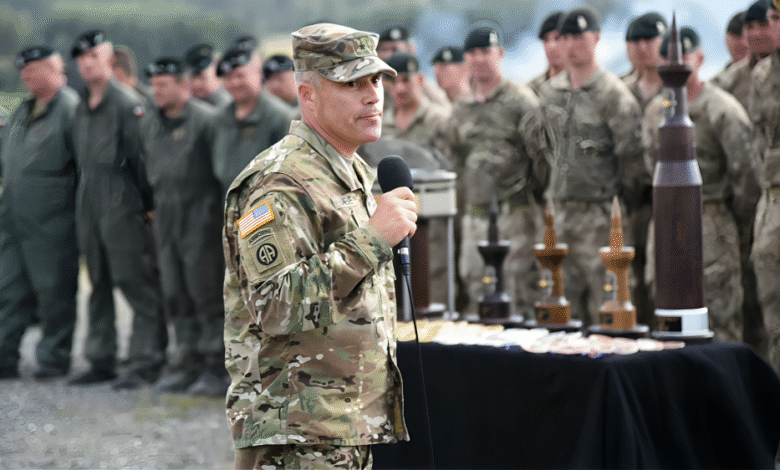
Major General Brandon R. Tegtmeier assumed command of the 82nd Airborne Division on August 28, 2025, bringing extensive experience from the 75th Ranger Regiment and prior roles as the division’s deputy commanding general. A West Point graduate with a mechanical engineering degree and advanced strategic studies credentials, he has led forces across multiple combat theaters. His background includes serving as executive assistant to the Chairman of the Joint Chiefs of Staff. Under Tegtmeier, the 82nd Airborne Division commander focuses on sustaining high readiness amid evolving threats. This leadership ensures the All Americans remain prepared for any contingency.
Key Operations and Leadership Impact Across Eras
82nd Airborne Division commanders have guided the unit through pivotal missions, from World War II assaults in Europe to recent operations in Afghanistan and Iraq. In 2021, elements supported Operation Allies Refuge during the Kabul evacuation, showcasing rapid crisis response. Modern deployments emphasize integration with allied forces and precision airborne insertions. Leadership during these events has refined doctrine for hybrid warfare environments. The cumulative impact of successive 82nd Airborne Division commanders underscores the division’s role as America’s strategic fire brigade. Their decisions have consistently delivered decisive results in support of national interests.
Training, Readiness, and Future Outlook Under Command
Rigorous training programs under the 82nd Airborne Division commander prepare paratroopers for diverse scenarios, including night jumps, urban assaults, and joint exercises. Emphasis on physical fitness, leadership development, and technological integration keeps the force agile. Future challenges, such as peer adversary threats, require ongoing innovation in equipment and tactics. The commander drives initiatives to enhance interoperability with international partners. This forward-looking approach ensures the division’s continued relevance. As global security dynamics shift, the 82nd Airborne Division commander remains instrumental in adapting the All Americans for tomorrow’s battles.
FAQs
Who is the current 82nd Airborne Division commander?
Major General Brandon R. Tegtmeier took command on August 28, 2025. A seasoned infantry officer and former Ranger Regiment leader, he previously served in key division roles and high-level Pentagon positions. His tenure emphasizes sustained readiness and operational excellence for the All Americans. Tegtmeier’s leadership builds directly on the division’s proud legacy of rapid global response.
What does the 82nd Airborne Division commander actually do?
The commander oversees all aspects of the division’s training, deployment, and mission execution as part of the XVIII Airborne Corps. Responsibilities include ensuring 18-hour alert status for parachute assaults and coordinating multi-brigade operations. This role demands strategic vision to balance combat effectiveness with soldier welfare. Every 82nd Airborne Division commander shapes how the unit projects power worldwide.
Who were some famous past 82nd Airborne Division commanders?
Notable leaders include Major General Matthew B. Ridgway, who directed World War II invasions of Sicily and Normandy, and Major General James M. Gavin, architect of key European operations. Earlier figures like Omar Bradley helped establish the airborne foundation. These commanders left lasting marks through tactical breakthroughs and inspirational leadership. Their examples continue to guide today’s 82nd Airborne Division commander.
Why is the 82nd Airborne Division commander position so important?
This command sits at the center of America’s rapid-reaction capability, enabling immediate intervention in crises anywhere on the globe. The commander ensures the division’s unique parachute expertise translates into battlefield success. In an era of unpredictable threats, effective leadership here directly supports U.S. national security objectives. The 82nd Airborne Division commander role demands the highest standards of military professionalism.
How has the role of the 82nd Airborne Division commander evolved?
From World War I infantry oversight to modern airborne command, the position now incorporates joint operations, advanced technology, and multinational coordination. Today’s commanders manage complex logistics for global deployments while preserving core parachute traditions. Evolution reflects broader Army transformations toward modular, expeditionary forces. The 82nd Airborne Division commander adapts continuously to maintain the unit’s elite status.
Conclusion
the 82nd Airborne Division commander stands as the driving force behind one of the U.S. Army’s most capable and historic units. From its World War I origins through transformative airborne developments and into contemporary operations, successive leaders have upheld a tradition of excellence and rapid response. The current commander, Major General Brandon R. Tegtmeier, continues this legacy with a focus on readiness and innovation. Understanding the 82nd Airborne Division commander reveals deeper insights into American military strength and the human elements that power elite forces. As global challenges persist, this leadership ensures the All Americans remain prepared to answer the call anytime, anywhere.